Virginia DUI: What You Need to Know
The information contained here was written by experienced Virginia DUI attorney Andrew Flusche and was last updated in August of 2026
Are you facing a DUI charge in Virginia? If so, we know you are worried about what you could be facing. Let’s take a look at the facts.
An Overview of DUI in Virginia
In Virginia, driving under the influence occurs when you drive or operate any motor vehicle while your blood alcohol concentration is 0.08 percent or higher, while under the influence of alcohol, while impaired by drugs, while impaired by a combination of drugs and alcohol, or with certain listed drugs in your blood at or above their statutory limit. Virginia Code § 18.2-266 makes DUI / DWI a class 1 misdemeanor, which is a significant criminal charge.
Potential penalties for a first-offense DUI in Virginia include a fine of up to $2,500, a jail sentence of up to 12 months, and a license suspension of up to 12 months.
If you have been charged with a DUI in Virginia, we are here to help. Please don’t hesitate to contact us to discuss your defense.
If your case is outside our area or our calendar is too full at the time, we will do our best to refer you to a qualified attorney in your area who can help.
What Are the Penalties for DUI in Virginia?
Infographic goes here
The biggest factor in determining jail time for a DUI is what your blood alcohol content is proven to be. In Virginia, if you’re found guilty of a first-offense Virginia DUI and the blood alcohol is .15 to .20, the law requires that the judge give you at least 5 days of jail. First-time DUI offenders face a minimum $250 fine and a one-year driver’s license revocation.
- If your blood alcohol content was over .20, the law requires at least 10 days in jail.
- If your blood alcohol was below .15, there is no mandatory jail.
- If you’re found guilty of DUI in Virginia, you’ll have to do VASAP – Virginia Alcohol Safety Action Program.
There’s, unfortunately, no way around this requirement if you’re convicted, even if the DUI was only for prescription medication!
Some courts might not require VASAP upon pain of going to jail; however, you would have to complete VASAP to clear your license with the Virginia DMV. VASAP is normally a minimum of 10 weeks of classes—two hours per class. Depending upon your record and substance abuse history, you may have to do additional things such as therapy and AA meetings.
Jail is definitely one of the top questions people have about their Virginia DUI charge. Are you going to jail, and if so, how much time might you get? Even setting aside the mandatory jail due to your blood alcohol content, you can still get jail—or more jail than the mandatory minimum.
One big factor around Fredericksburg that can give you jail time is if your case involved an auto accident. Some prosecutors push hard for jail in those cases.
How Long Does a First-Offense DWI Stay On Your Record?
If you’re charged with a DUI in Virginia, you need to know that it’s a Class 1 misdemeanor. It’s the most serious level of misdemeanor in Virginia. Clients and potential clients routinely ask us how long this offense will stay on their record. Unfortunately, the news is that it will be on your criminal record forever. A Virginia criminal history covers your entire life, so a misdemeanor conviction on your criminal history will be there forever.
The good news is that a DWI only stays on your Virginia driving record for 11 years. If someone is just looking at your Virginia driving transcript, then the DWI conviction will only be there for 11 years. That’s still a long time, but at least it’s not the rest of your life.
Can You Be Charged with a Drug DUI in Virginia?
Many people associate a DUI in Virginia with alcohol, but Virginia DUI laws also prohibit driving while impaired by drugs. That includes illegal drugs, prescription medications, over-the-counter medications, and combinations of drugs and alcohol that affect your ability to drive safely.
Examples include:
- Prescription medications—such as opioid pain relievers, muscle relaxers, sleep aids, or anti-anxiety medications that impair your ability to operate a vehicle safely;
- Illegal drugs—including cocaine, methamphetamine, heroin, and other controlled substances;
- Marijuana—when prosecutors believe it impaired your driving, even though certain marijuana use is legal in Virginia; and
- Combined alcohol and drug use—even if neither substance alone would have resulted in a DUI charge. Virginia law prohibits driving while under the combined influence of alcohol and drugs.
Virginia law also establishes specific blood concentration thresholds for certain drugs. A driver may be prosecuted based on one of those statutory concentrations or based on evidence that another drug impaired the driver’s ability to operate safely. Virginia does not establish a general per se blood limit for every controlled substance, prescription medicine, or marijuana.
Unlike many alcohol cases, drug DUI prosecutions often rely on more than a breath test. Prosecutors may use blood test results, officer observations, field sobriety tests, witness testimony, and statements made during the investigation to try to prove impairment.
Drug DUI cases frequently involve scientific evidence and questions about whether the Commonwealth can prove actual impairment. We can evaluate whether the testing procedures, evidence, and investigation comply with Virginia law.
Virginia DUI: Answers to Your Questions
Jump-to the information you need:
Are Virginia DUI Laws Different for Underage and Commercial Drivers in Virginia?
While the standard legal blood alcohol concentration (BAC) limit is 0.08%, Virginia DUI laws impose stricter standards for drivers under 21 and those who hold commercial driver’s licenses (CDLs).
Different BAC limits apply to:
- Drivers under 21. Virginia law prohibits drivers under 21 from operating a vehicle after illegally consuming alcohol. A BAC of 0.02% but less than 0.08% violates the underage statute. A conviction can result in a one-year license suspension, a mandatory minimum fine, and completion of the Virginia Alcohol Safety Action Program (VASAP).
- Commercial driver’s license (CDL) holders. A CDL holder may be charged with a DUI while operating a commercial vehicle with a BAC of 0.04% or higher, which is half the legal limit for most other drivers. Federal and state laws also authorize the disqualification of commercial driving privileges following certain DUI convictions.
Even if you hold a CDL but were driving your personal vehicle at the time of your arrest, a DUI conviction may still affect your commercial driving privileges. Because a commercial license often supports a person’s livelihood, promptly defending against these charges is especially important.
How Do I Get My License Back Before the Trial?
If you are charged with a Virginia DUI, you will have a 7-day suspension of your license for a first offense—or a 60-day suspension for a second offense. After the pre-trial suspension is over, you should be able to pick your license up in person at the clerk’s office. They will sometimes mail it to you as well. If the clerks don’t have your license or it gets lost in the mail, you can request a re-issue of your license from the Virginia DMV.
Can I Get My Virginia DUI Reduced to “Wet Reckless”?
Many clients understand that they may not beat their case completely, but they’re trying to see if they can at least get a break from a DUI conviction. Lots of websites and online forums talk about getting a Virginia DUI reduced to a “wet reckless” outcome to achieve exactly that goal.
A “wet reckless” is a slang term for convicting you of reckless driving but adding punishments such as VASAP and license suspension because you were originally charged with DUI.
Unfortunately, this isn’t usually possible in the courts around Fredericksburg, Stafford, Spotsylvania, King George, and Caroline. In the courts where we practice, the prosecutors normally want a DUI conviction if they can prove it. To try to avoid the DUI, we normally have to fight the case head-on.
What If the Officer Doesn’t Have a Video?
Many people are used to shows like CSI and Law & Order where video and other physical evidence are often used to prove the state’s case. Unfortunately, real criminal cases aren’t usually based on the video. In most Virginia DUI cases, there will be no video. Many cruisers aren’t equipped with video, and they often malfunction. Also, sometimes the video is angled in a way that you’re not even on it.
The lack of video does NOT help us. In fact, it often hurts the defense.
Most judges lean toward believing whatever the law enforcement officers say in court, so they don’t need the video to establish their case. However, video can help us to show that the facts aren’t as bad as they might sound—and sometimes the officer might be completely mistaken in their testimony. But if there’s no video, we won’t have a way to demonstrate that.
Can We Win If the Officer Didn’t Read Me My Rights?
Your Miranda rights or “warnings” are only required if you are being interrogated while in custody. And then, the remedy for not reading your rights to you is that any answers you give are not admissible in court. How does this apply to a Virginia DUI? Usually, the police will get all the evidence they need for their case before you’re actually in custody. They ask you about where you’re coming from, what you drank, when your last drink was, etc. Then they have you do field sobriety tests and the handheld breath test. Only after all that are you normally placed into custody.
That’s when your Miranda rights should be read to you. But if the officer forgets to read your rights to you, there may not be any harm to the Commonwealth’s case. The only remaining evidence they usually need after your arrest is to prove your blood alcohol content, and Miranda doesn’t really apply to that test. With that said, there are some cases where the officer continues to ask questions after you’re arrested. If they haven’t read your rights to you, then we can hopefully exclude any answers that you gave.
Will I Be Able To Drive To Work?
If you are found guilty of first offense DUI, Virginia law requires that your Virginia license (or privilege to drive in Virginia) is suspended for one year. The good news is that in most courts you’d be immediately eligible for a restricted driver’s license to let you drive for work, school, childcare, church, etc. You would have to install an ignition interlock on whatever vehicle you’re driving for at least 12 consecutive months without an alcohol-related violation. On the driver’s motion, a court may reduce the interlock period to at least six violation-free months if it imposes additional geographic restrictions for the entire 12-month restricted license period.
Virginia law used to have different restricted license options for people with a blood alcohol level above .15, but that was changed to make all first offense restricted licenses the same. Now everyone by default gets “interlock only” as their sole restriction on a first offense, unless you request otherwise.
Second offense DWI convictions also used to have a waiting period of 4 or 12 months before you could request a restricted license. That requirement was eliminated on July 1, 2026. Now, all DWI 2nd offenders can immediately obtain a restricted license, assuming the court permits it.
Will I Need FR-44 Insurance After a Virginia DUI?
For many drivers, a conviction for a DUI in Virginia means meeting additional insurance requirements before getting back on the road. One of those requirements is filing an FR-44 certificate, which proves you carry automobile liability insurance that meets Virginia’s higher coverage requirements for certain drivers.
An FR-44 requirement generally means:
- Higher liability coverage than Virginia’s standard minimum insurance requirements;
- Continuous insurance coverage, since a lapse can result in another license suspension; and
- Proof of coverage filed by your insurance company with the Virginia Department of Motor Vehicles before your driving privileges can be reinstated.
Not every insurance company offers policies accompanied by an FR-44 filing, and drivers often see their premiums increase after a DUI conviction. Understanding these requirements early can help avoid delays when you’re eligible to have your license reinstated.
If you’re facing charges under Virginia DUI laws, speaking with an attorney before your case is resolved may help you better understand the long-term consequences a conviction could have on both your driving privileges and your insurance obligations.
DUI vs. DWI in VA: What’s the Difference?
DUI and DWI in VA are basically interchangeable slang terms for the same basic offense: Operating an engine under the influence of something. People often ask what the difference is between DWI and DUI in Virginia. Frankly, there isn’t any difference. They are both just slang terms for the same thing.
Virginia law, under section 18.2-266, prohibits operating a motor vehicle–any kind of engine, or even a train–if you’re under the influence of drugs or alcohol, or any kind of substance that alters your abilities to drive or operate the vehicle safely. So it’s a very broad statute. DUI covers the operation of just about any kind of engine, under pretty much any circumstances when your abilities are impaired. That could be due to alcohol, which is most common, it could be due to drugs such as marijuana, or it could be due to medicine your doctor gave you. Even a prescription medicine could be a DUI.
Why Do We Call Them DUI or DWI?
Frankly, we use the term DUI just because it’s easier to say. DWI is a bit more cumbersome, so we just call it DUI. The Virginia courts, on your paperwork, if you’re charged with a violation under 18.2-266, typically write DWI. What that stands for is Driving While Intoxicated, so that’s usually an alcohol charge.
However, the statute covers basically driving under the influence of just about anything, so that’s where DUI comes from Driving Under the Influence. So if you have a drug charge, for example, there is actually another acronym you might see called DUID, which is Driving Under the Influence of Drugs. But as you can see, it’s all under the same statute. It’s all prohibiting operating an engine while under the influence of something. That’s why we typically just refer to all in shorthand as DUI and many attorneys and defendants do as well.
There is really no distinction. DUI, and DWI, it’s all the same type of charge, and it’s really the same offense.
There are different little things the Commonwealth may have to prove, such as what actually was in your system, but in every case, they have to prove operation, and that you were actually under the influence of something. So no matter what it’s called, DUI or DWI, it’s certainly a serious charge and you’re still facing the same penalties, which would be a one-year loss of license, depending on the actual case, perhaps some jail and that kind of thing. So you definitely want to talk with an experienced DUI/DWI attorney about your case. Contact us today at 540-369-2705 to discuss your case and learn how we can help you.
Recent Case Result: Spotsylvania DWI Dismissed on Appeal
(Cases depend upon unique facts. Past cases do not guarantee future outcomes.)
THE STORY:
Jane hired our firm for a serious Spotsylvania DWI charge related to a vehicle accident. We immediately knew that the Commonwealth would have trouble proving that Jane was actually intoxicated at the time of the alleged driving.
The discovery process revealed several weaknesses in the government’s case against Jane. It was not clear that she was even the driver of the vehicle to begin with. And the government investigators could not explain about two hours of time between the accident and when they encountered Jane. Had she been drinking during that time?
The original trial judge in General District Court did not think there was reasonable doubt in Jane’s case, but she exercised her right to appeal to the Circuit Court. In Virginia, that appeal provides a brand new trial with a different judge.
On appeal, we fought many issues including Jane’s arrest itself, the admissibility of the breath certificate, and finally whether or not Jane consumed alcohol between the accident and her arrest.
CASE OUTCOME:
The judge acquitted Jane because there was reasonable doubt whether or not she was actually intoxicated at the time of the driving.
[INFOGRAPHIC] VIRGINIA’S MOST SHOCKING DUI STATISTICS
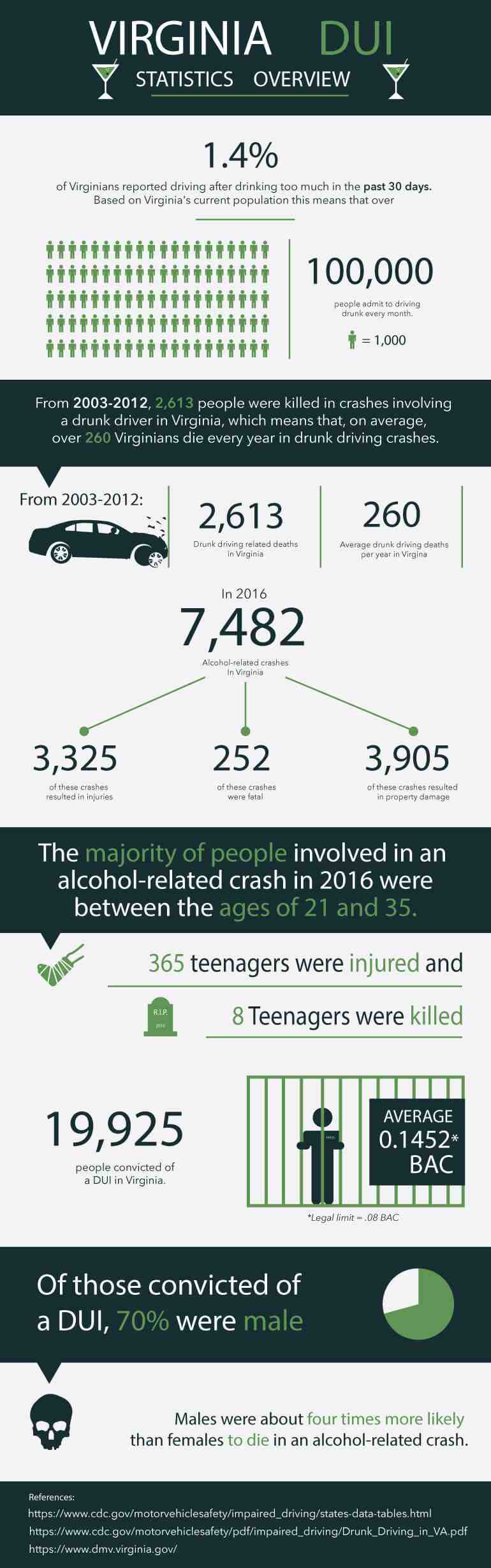
1.4% of Virginians have reported that they drove while drunk in the past 30 days. Not only is driving a vehicle while impaired a serious crime, it also puts your life and the lives of others in danger.
Drunk Driving in Virginia
Alcohol remains a factor in roughly one out of every three fatal crashes in Virginia. In 2024, 318 people died, and more than 4,300 suffered injuries in alcohol-related crashes across the Commonwealth. Although driving becomes illegal when a person is impaired with a blood alcohol concentration (BAC) of .08 percent or greater—or .04 percent for commercial drivers—any level of impairment can be very dangerous.
Alcohol-Related Incident Statistics
The Virginia Department of Motor Vehicles reported 6,767 alcohol-related crashes in 2024. Of those, 302 were fatal crashes, 2,695 caused injuries, and 3,770 resulted only in property damage. These crashes killed 318 people and injured 4,306 others.
Drivers between 21 and 35 represented the largest age group involved in alcohol-related crashes. Virginia recorded 3,227 drinking drivers in that age range, accounting for nearly half of the 6,610 drinking drivers identified that year. Alcohol-related crashes also killed 19 people and injured 266 people between the ages of 15 and 19.
Virginia recorded 14,602 DUI convictions in 2024, a 2.5% increase from 2023. Men accounted for 66.6% of those convictions, while women accounted for 24%. The 2024 report does not provide an average BAC for people convicted of DUI, so that outdated figure should be removed rather than replaced.
What Happens If I Refuse the Chemical Test Offered by the VA Police?
The answer to that question depends on the type of test the officer asked you to take.
Preliminary Breath Test (PBT)
Law enforcement officers in Virginia can ask you to take a preliminary breath test or PBT for short. Virginia’s DUI law allows the officer to give you the PBT as part of an investigation into drunk driving. The investigating officer usually asks people to take the PBT on the side of the road before asking them to take field sobriety tests. The officer will ask you to blow into a machine that supposedly measures the amount of alcohol in your breath.
You DO NOT have to take this test. In fact, you can—and should—refuse this test. No good can come if you take it. The officer will only use the result to build a case against you. Also, the police cannot use your refusal to take the PBT against you in court. In addition, there’s no penalty in Virginia for refusing the PBT. PBTs are notoriously unreliable, which is why police officers can only use them to find probable cause for arrest. The chances of you taking the test and passing are minimal if you’ve had a drink or two. Also, the officer will keep investigating if you pass the test anyway.
Breathalyzer or Blood Tests
Virginia law treats breathalyzers and blood tests differently than PBTs. In Virginia, you “consent” to taking a chemical test if a police officer arrests you for DUI. Of course, you never actually consent to take the breathalyzer or blood test. Rather, Virginia law “implies” you consented to take a chemical test when you drive on a public way in the Commonwealth.
Under Virginia’s implied consent law, you cannot “unreasonably refuse” to take a chemical test after a DUI arrest. Unreasonable refusal means that you refused to take a chemical test if the police had probable cause to arrest you for DUI and they offered the test within three hours of the arrest. The officers must give you your rights regarding chemical tests as well.
Unreasonably refusing a chemical test violates Virginia law. A person’s first refusal to take a chemical test is a civil infraction. The penalty results in a suspension of your driving privileges for one year. Virginia law treats subsequent refusals as misdemeanor offenses. There’s one additional consequence for refusing a chemical test: the prosecution can admit your refusal against you at trial.
Do I Have a Defense If I Take a Chemical Test?
Yes. You are not automatically guilty if you take a chemical test. The Commonwealth must prove that the police followed correct procedures to administer the test. Also, the prosecution has to prove the device was in working condition at the time you gave the sample. Furthermore, the Commonwealth has to prove the test is reliable. A highly experienced DUI defense lawyer in Virginia will scrutinize all the evidence to give you the best defense possible, even if you “failed” a chemical test, meaning your test results were 0.08% or higher. Having a skilled DUI Virginia defense lawyer examine your case may help you come up with other defenses as well.
You could knock out all the evidence if you successfully argue that the police had no justification to pull you over in the first place, for example.
I Have a DUI from Another State—Can that Be Used Against Me?
Yes. The Commonwealth can use evidence of an out-of-state DUI conviction to prove that the court should treat you as a repeat offender. If you have a second offense within five years, then the court must sentence you to jail for 30 days but no longer than one year. Twenty days out of the 30 are mandatory. The judge must also impose a $500 fine.
If, however, your first DUI was between five and 10 years ago, then your possible punishment is a $500 fine and 30 days in jail, and you must serve 10 days in jail before release.
A conviction of 10 years or older will not qualify to classify you as a repeat offender. However, the judge could impose a maximum sentence of one year without any mandatory time.
Keeping your record clean is important because the penalties for repeat offenders are harsh.
We can devise a personalized strategy to defend your DUI case and minimize your risk of becoming a repeat offender.
Frequently Asked Questions About DUI in Virginia
Can I Be Charged with a DUI in Virginia for Driving Under the Influence of Prescription Medication?
Yes. A person may be charged with a DUI in Virginia if prescription medication impairs the ability to operate a motor vehicle safely. The medication does not have to be illegal or improperly prescribed. The Commonwealth must prove that the drug affected the driver’s ability to operate the vehicle safely.
What Is VASAP, and Is It Required for Drug DUI?
VASAP is the Virginia Alcohol Safety Action Program, which conducts screening, education, monitoring, and treatment referrals. Virginia generally requires a person convicted under § 18.2-266 to enter and successfully complete the program. That includes convictions based on drugs or prescription medication, not only alcohol-related DUI convictions.
Will a DUI Conviction Affect My Commercial Driver’s License?
Yes. A DUI conviction can lead to the disqualification of your commercial driving privileges, even if you were driving your personal vehicle at the time of the arrest. Because commercial drivers are subject to both Virginia and federal regulations, a conviction can have serious employment consequences.
Can I Be Charged with a DUI in Virginia if I Was Sleeping in My Parked Car?
Possibly. Virginia courts have held that a person may be convicted of DUI without the vehicle actually being in motion. Depending on the circumstances, prosecutors may argue that you were operating or in actual physical control of the vehicle while under the influence.
What Are the Extra Penalties If a Child Was in the Car?
If a person commits a DUI while transporting someone 17 or younger, a conviction carries an additional mandatory minimum of five days in jail and an additional fine of $500 to $1000. These penalties are added to other applicable DUI penalties.
Can I Refuse Field Sobriety Tests During a Virginia DUI Stop?
Yes. Unlike the post-arrest breath or blood test required under Virginia’s implied consent law, roadside field sobriety tests are 100% voluntary in Virginia. An officer may still arrest you based on other evidence of impairment; however, politely refusing the physical field sobriety tests gives us a better chance to fight the arrest.
How Long Will a DUI Affect My Car Insurance?
A DUI conviction often results in higher insurance premiums and may require you to obtain FR-44 insurance before your driving privileges can be reinstated. How long those increased costs last depends on your insurance carrier, driving history, and other underwriting factors.
Can a Virginia DUI Be Expunged from My Criminal Record?
A DUI charge may potentially be expunged under Virginia’s traditional expungement statute when it ends without a conviction and the statutory requirements are met. A DUI conviction generally cannot be expunged, and DUI is not included among the misdemeanor convictions eligible for petition-based sealing under Virginia law.
Do I Have to Install an Ignition Interlock Device for a First-Offense DUI In Virginia?
If you are convicted of a first-offense DUI and receive a restricted driver’s license, Virginia law generally requires you to install an ignition interlock device on any vehicle you operate during the required restriction period. The device must be installed and monitored in accordance with Virginia law and VASAP requirements.
My name is Andrew Flusche, and I am a traffic and misdemeanor defense lawyer serving Fredericksburg, Spotsylvania, Stafford, King George, Caroline, and the surrounding communities of Northern Virginia. As the founding partner of Flusche & Fitzgerald, Attorneys at Law, I have focused exclusively on traffic tickets and misdemeanor defense since 2008. I literally wrote the book on reckless driving in Virginia, available free here or on Amazon, and I hold my Juris Doctor from the University of Virginia School of Law. With over 600 five-star reviews on Google, Yelp, and Facebook, and membership in the Fredericksburg Area Bar Association and the Virginia Association of Criminal Defense Lawyers, I bring local knowledge and proven results to every case. If you’ve been charged with a traffic or misdemeanor offense in Virginia, contact me today. Your initial consultation is always free and you’ll speak directly with me.
Official Legal and Other Sources Used to Inform This Page
To ensure the accuracy and clarity of this page, we referenced official legal and other sources during the content development process:
- Va. Code § 18.2-266. Driving motor vehicle, engine, etc., while intoxicated, etc.
- Va. Code § 18.2-268.9. Assurance of breath-test validity; use of breath-test results as evidence.
- Va. Code § 18.2-268.2. Implied consent to post-arrest testing to determine drug or alcohol content of blood.
- Va. Code § 18.2-268.3. Refusal of tests; penalties; procedures.
- C.F.R § 383.51 Disqualification of drivers.
- Va. Code §§ 46.2-341.18. Disqualification for certain offenses.
- Va. Code § 46.2-341.19. Controlled substance felony; disqualification.
- See Va. Code § 46.2-411. Reinstatement of suspended or revoked license or other privilege to operate or register a motor vehicle; proof of financial responsibility; reinstatement fee.
- VA. Code § 18.2-268.3. Refusal of tests; penalties; procedures.
- VADMV: Financial Responsibility Certifications
- Va. Code § 19.2-392.2. (Effective until December 1, 2026) Expungement of police and court records.
- Va. Code § 46.2-472. Coverage of owner’s policy.
- Va. Code. § 18.2-270.1. Ignition interlock systems; penalty.
- Va. Code 18.2-271.1. Probation, education, and rehabilitation of person charged or convicted; person convicted under law of another state or federal law.
- Commonwealth of Virginia, 2024 Virginia Traffic Crash Facts
- Va. Code § 18.2-270. Penalty for driving while intoxicated; subsequent offense; prior conviction.
- VA. Code § 18.2-267. Preliminary analysis of breath to determine alcoholic content of blood.