Guide to Virginia Car Seat Laws
A first violation carries a $50 civil penalty. A second or later violation on a different date carries a penalty of up to $500 (Va. Code § 46.2-1098). The court cannot suspend the $50 penalty, but it may waive it if you could not afford a child restraint. No demerit points and no court costs are assessed. The offense is primary, so an officer can stop you for this violation alone. An accident involving an improperly restrained child can have catastrophic consequences, which is why the law treats proper car seat use as a safety requirement.
Here is a quick guide to Virginia car seat laws. Of course you should always refer to your car seat manual for specific height and weight specifications.
This guide will show you the type of seat you need for your child’s age group, how to find out if it is installed correctly and what penalty you will be facing for not using a car seat at all.
Key Takeaways
- Virginia law requires all children to use an appropriate safety seat through age seven; the transition happens only when the child turns eight.
- Children should use a rear-facing seat until they exceed the manufacturer’s height and weight limits, then move to a forward-facing seat with a harness.
- A booster seat is required after the child outgrows the forward-facing seat, and should be used until the adult seat belt fits properly across the chest and lap.
- Each baby or child in a car seat counts as a separate occupant for HOV lane purposes—an unborn child does not.
- Violating Virginia’s child safety seat law carries a $50 fine for a first offense, rising to as much as $500 for subsequent violations. Because it’s a primary enforcement offense, an officer can stop you specifically for this violation alone.
- Refer to your specific car seat manual for the height and weight limits that determine when to transition between seat types.
- When in doubt, consult a certified Child Passenger Safety Technician for guidance on proper installation and fit.
NOTE: The law changed on July 1, 2019 – ALL child restraint devices must be in the back seat (unless the vehicle has no back seat).
Virginia’s Car Seat Stages by Age
Rear-Facing Seats: Birth to Age 2
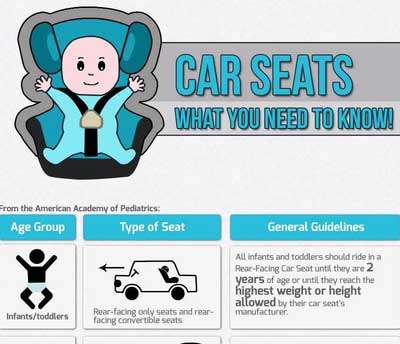
Under Virginia law, children must ride in a rear-facing car seat until they turn 2 years old, or until they reach the minimum weight limit set by the manufacturer for a forward-facing seat. Safety experts recommend keeping children rear-facing until they reach the maximum height or weight limit allowed by the car seat manufacturer. Rear-facing seats must be installed in the back seat.
Forward-Facing Seats with a Harness: Age 2 Until Outgrown
Once a child turns 2 (or outgrows the rear-facing limits), they move to a forward-facing seat with a five-point harness, used until reaching the maximum height or weight limit specified for that seat.
Booster Seats: Until Age 8 (and Beyond)
Virginia law requires children to be secured in an approved child restraint or booster seat through age 7 (until their 8th birthday). A booster seat should be used with both a lap and shoulder belt.
Seat Belt Alone: Age 8 and Older
Once a child turns 8, a booster seat is no longer legally required in Virginia. However, safety experts strongly advise using a booster seat until the child reaches 4’9”in height and can pass the seat belt fit test.
| Stage | Age | Seat | Legal requirement | Recommendation on the page |
|---|---|---|---|---|
| Rear-facing | Birth to age 2 | Rear-facing, back seat | Rear-facing until age two or the manufacturer’s minimum weight for forward-facing (§ 46.2-1095) | Until the maximum height or weight limit |
| Forward-facing with harness | Age 2 until outgrown | Five-point harness | Seat appropriate for the child | Until the seat’s maximum limits |
| Booster | Through age 7 | Booster with lap and shoulder belt | Child restraint required through age 7 | Until the belt fits |
| Seat belt alone | Age 8 and older | Vehicle seat belt | Booster no longer required | Booster until 4’9″ and the belt fit test is passed |

Free to Use!
You are free to use our graphic anywhere online, as long as you include our link below. Just copy and paste this embed code in your website:
Thumbnail
If you need a small image to display on your website, here it is:
Contact us today at 540-318-5824 to discuss your case and learn how we can help you.
| Violation | Penalty | Source |
|---|---|---|
| First violation | $50 civil penalty | § 46.2-1098 |
| Second or subsequent violation on a different date | Up to $500 civil penalty | § 46.2-1098 |
| Failure to carry the required statement | Additional $20 | § 46.2-1098 |
Frequently Asked Questions:
What are the booster seat requirements in Virginia?
In Virginia, children must use an appropriate child restraint through age 7. After a child outgrows a forward-facing car seat, the child should transition to a booster seat according to the manufacturer’s height and weight limits. The child should continue using the booster until the vehicle’s seat belt fits correctly across the chest and lap. Check the car seat manual for the manufacturer’s requirements.
When can a child stop using a car seat in Virginia?
In Virginia, a child must use an appropriate child safety seat until they turn eight years old. The transition between seat types, from rear-facing to forward-facing to booster, is governed by the child’s height and weight relative to the manufacturer’s specifications for each seat, not by age alone. Once a child turns eight and the vehicle’s seat belt fits properly without a booster, they may use just the seat belt, though it is always safer to keep children in the appropriate seat as long as they still fit within the manufacturer’s limits.
Does a rear-facing car seat count as a passenger for Virginia HOV lane purposes?
Yes, each child properly secured in a car seat counts as a separate occupant for HOV lane purposes in Virginia. An unborn child does not count. So if you are driving with two young children in car seats, all three of you count toward the occupancy requirement for HOV lanes, which is worth knowing if you commute on I-95 or I-395 in Northern Virginia.
What is the penalty for not using a car seat in Virginia?
A first violation carries a $50 civil penalty. A second or later violation on a different date carries a penalty of up to $500 (Va. Code § 46.2-1098). The court cannot suspend the $50 penalty, but it may waive it if you could not afford a child restraint. No demerit points and no court costs are assessed. The offense is primary, so an officer can stop you for this violation alone. An accident involving an improperly restrained child can have catastrophic consequences, which is why the law treats proper car seat use as a safety requirement.
Can you be pulled over specifically for a car seat violation in Virginia, or does it have to be a secondary offense?
You can be stopped specifically for a car seat violation, since Virginia treats it as a primary offense, meaning an officer doesn’t need another reason, like speeding, to initiate the stop.
Does the Virginia car seat law apply to grandparents or other family members driving a child, not just parents?
Yes. The law applies to whoever is driving the vehicle with the child inside, regardless of their relationship to the child, so a grandparent, babysitter, or other driver can be cited just as a parent could be.
Can a child ride in the front seat once they’re old enough to stop using a booster seat?
Virginia law itself doesn’t set a specific minimum age for a child to sit in the front seat once they’ve outgrown a booster and fit the seat belt properly, though many child safety experts recommend delaying front-seat riding well beyond that point given the added risk from airbags.
Can a parent be cited for a car seat violation if the correct seat was in the vehicle but not used correctly?
Yes, potentially. An officer can issue a citation if the safety seat isn’t being used properly, such as being unbuckled or the wrong type for the child’s age and size, even if the correct seat itself was present in the vehicle.